
Labuan vs. Malaysia’s PVIP: The Quiet Alternative Path to Long-Term Residency Through Business Structuring

By: Azean Ventures – The Azean Angle.
Malaysia now has two very different “economic routes” that foreigners can use to live long-term in the country — even though only one of them is openly marketed as an immigration pathway.
On one side is PVIP (Malaysia Premium Visa Programme), a straightforward “Golden Visa”-style residency pathway with published criteria and a clear 20-year structure.
On the other is Labuan, a low-tax offshore jurisdiction that is not promoted as an immigration product — yet it quietly offers a powerful, legitimate, regulatory-compliant route for long-term residence if someone’s business activities fit Labuan’s rules.
At Azean Ventures, we have long highlighted that for entrepreneurs, digital businesses, traders, IP owners, and cross-border operators, a properly structured Labuan company can become a lower-cost, business-driven alternative to traditional residency programmes — without ever positioning it as “immigration”.
This article explains how.
1. PVIP in Brief: Straightforward Golden Visa–Style Residency Route.
PVIP is Malaysia’s flagship long-term residency programme built on economic contribution and financial capacity.
A summary of the key criteria:
20-year residency, renewable in 5-year tranches (the 5-year cycle exists so the government can periodically review activity, compliance, contribution, and background status).
RM1 million fixed deposit in Malaysia, with partial withdrawal allowed after year 1 for property, health, and education expenses.
RM200,000 participation fee for the main applicant.
PVIP is clean, predictable, and appropriate for individuals who want a residency product with no operational obligations.
But PVIP is also expensive – and it does not create a business footprint.- – meaning:
PVIP = Residency only; you buy the right to stay, work or do business.
Labuan = Business activity that qualifies you for residency.
This is precisely why Labuan is a subtle but powerful alternative pathway for foreigners who want both:
a long-term residence in Malaysia, and
a commercially useful offshore business structure;
without the high up-front financial investment / commitments.
2. Labuan: The Business-Driven Alternative.
Labuan is a Federal Territory operating as Malaysia’s officially designated offshore financial centre. It is not a “visa programme”. It is not marketed as a residency pathway.
Instead, it is designed as:
a low-tax jurisdiction (3% corporate tax) for qualifying business activities
a regulated financial centre for international trading, services, fund structures, IP holding, leasing, and fintech
a substance-based jurisdiction, requiring real operations, staff, and presence in Labuan
Here is the key insight:
If a foreign entrepreneur sets up a Labuan company that meets substance rules and they are appointed as directors, they can apply for a Labuan work permit — a 2-year renewable visa that also allows their spouse and children to reside anywhere in Peninsular Malaysia.
This is not immigration-by-investment. It is immigration-by-business-activity.
3. Why Many Entrepreneurs Prefer Labuan Over PVIP.
3.1 Lower Cost (When the Business Is Real and Revenue-Generating).
PVIP requires RM1 million locked into a fixed deposit and a RM200k fee. As well as evidence of another RM1 million in liquid assets in any jurisdiction.
Labuan requires operating a real business which can be capitalized as the entrepreneur needs — meaning it can be significantly cheaper if the business already exists or if the applicant plans to run a profitable cross-border venture. There is no minimum investment. In theory, the paid-up capital can be as low as US$1.
For the right type of business, Labuan can become:
a 3% corporate tax jurisdiction.
a regional HQ for Asia-Pacific.
a clean legal base for cross-border revenue flow.
a gateway for director-level visas.
3.2 Residency Through Economic Activity, Not Through Deposit Locks.
A Labuan work permit allows:
The director to live and work from anywhere in Peninsular Malaysia.
The director’s spouse and children to stay under dependent passes.
Multi-year renewals as long as the company remains active.
This is effectively long-term residence achieved through business contribution.
4. Ongoing Costs of Maintaining a Labuan Company.
Unlike PVIP, where costs are fixed and financial commitments are high, Labuan only requires operating costs as the entrepreneurs decide – because it is an actual jurisdiction for doing real business.
A. Mandatory Ongoing Requirements
1. Physical Office in Labuan
Required under substance rules
Approx. US$3,500 per annum for a basic compliant office.
2. Minimum Two Labuan-Based Employees
Mandatory for businesses claiming the 3% tax rate
Salary: minimum RM1,800 per month per employee (approx US$12,000 per annum including statutory contributions)
3. Corporate & Compliance Costs
Annual trust company fees
Audit fees
Tax filing and compliance fees
Typical total: ≈ US$4,500 per year
B. Overall Annual Cost Estimate
Approximately Between US$15,000 – US$20,000 per annum (varies depending on activity level).
Director Income Requirement for Residency
Each director seeking a work permit and relocation for their family must show:
Minimum income: RM10,000 per month
Can this income come from the Labuan company?
Yes — provided that:
the business is real,
the revenue flows through Labuan, and
the compensation is commercially reasonable.
However, this director salary becomes taxable personal income in Malaysia under standard resident tax rates, after normal allowances.
This is why a revenue-generating Labuan business is essential — to allow each relocating director to legitimately draw RM10k monthly.
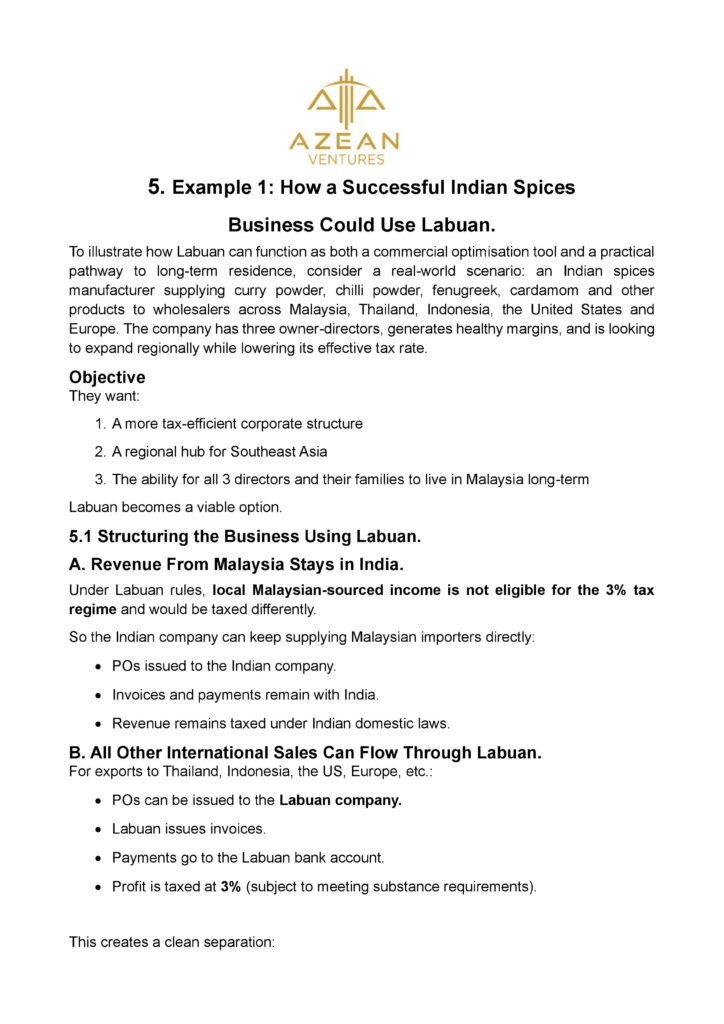
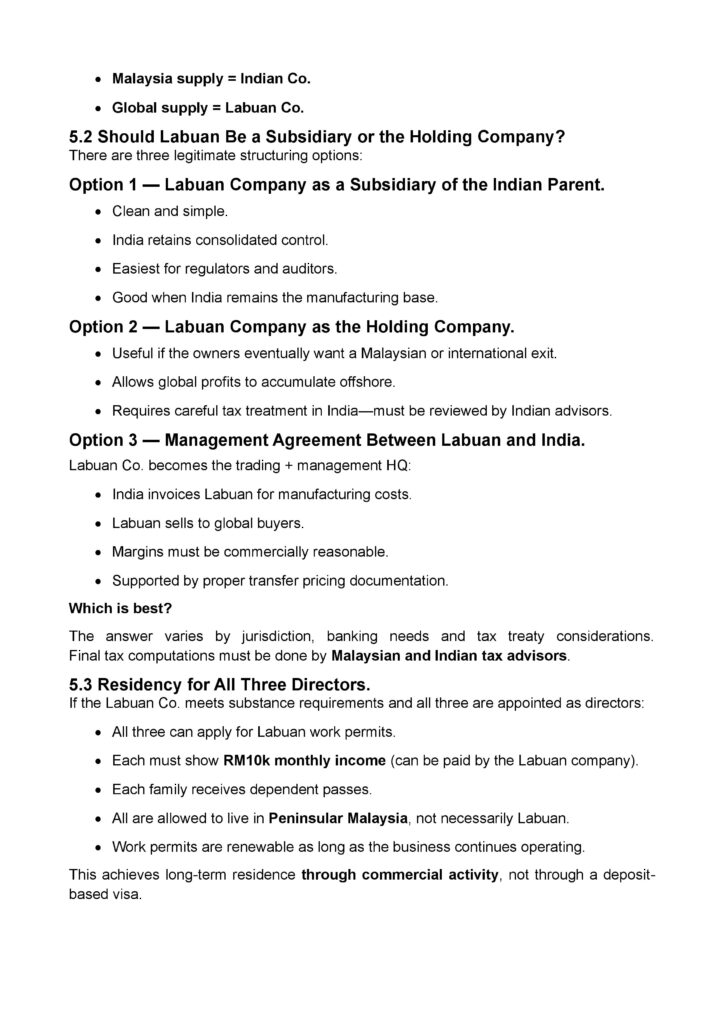
5. Example 1: How a Successful Indian Spices Business Could Use Labuan.
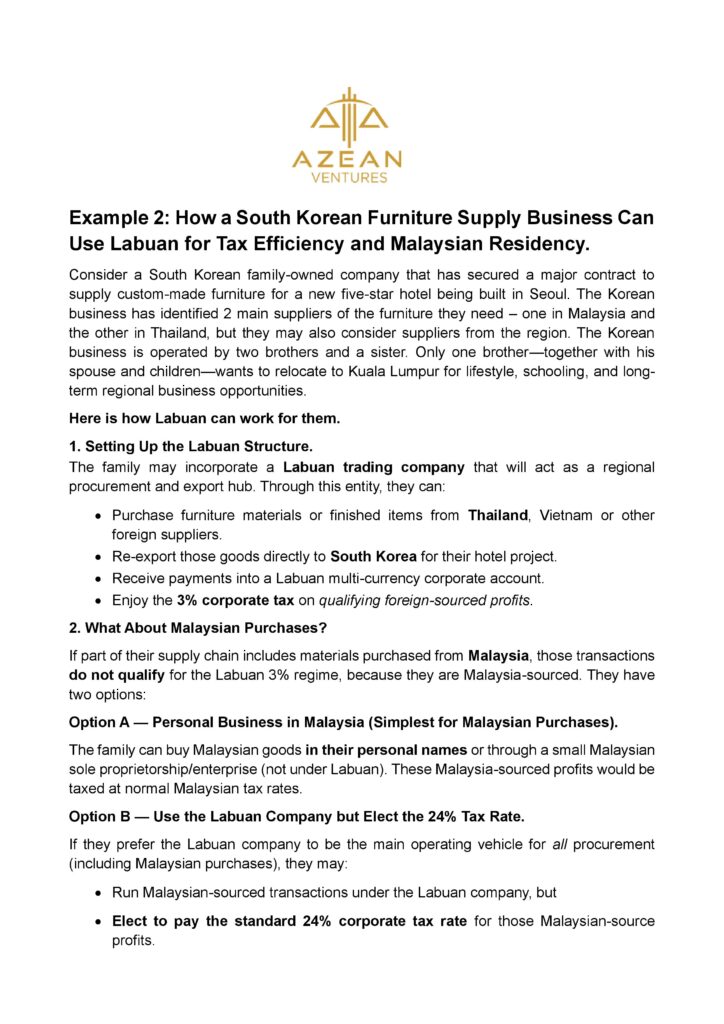
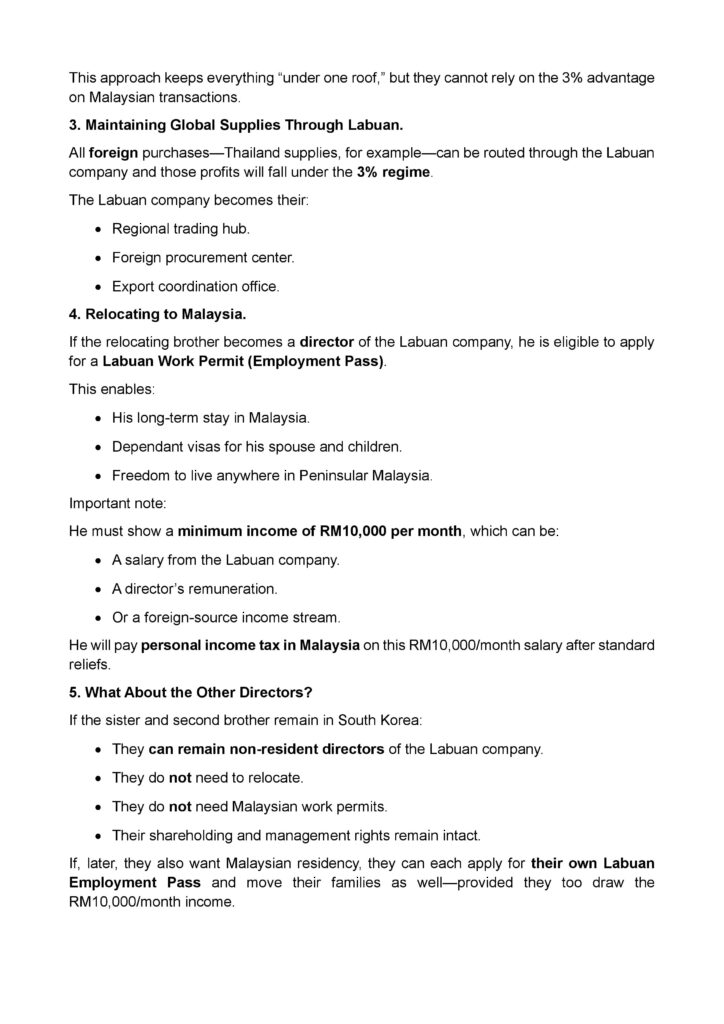
6. Example 2: How a South Korean Family Business Could Use Labuan.
7. PVIP vs. Labuan (Summary).
| Feature | PVIP | Labuan (Business Route) |
|---|---|---|
| Nature | Golden Visa | Business-driven work permit |
| Residency Type | 20-year, renewable | Renewable 2-year work permits |
| Requires Business Activity? | No | Yes, real operations |
| Minimum Costs | RM1M FD + RM200k fee + RM1M Liquid Funds | ≈ USD 15k – 20k annual operational cost |
| Tax Benefits | None | 3% corporate tax |
| Suitable For | Individuals with financial strength | Entrepreneurs with cross-border business |
8. Final Thoughts.
PVIP is ideal for financially strong individuals who want a clean, deposit-based residency option with no operational obligations.
Why Azean Ventures Highlights Labuan (Quietly but Consistently).
Because for many global founders, PVIP is overkill. They don’t need a prestige visa. They need a base, a structure, and a country to live in with their family—while running a real, profitable business. And for this group, Labuan provides a pathway that is:
Cheaper.
More flexible.
More commercially meaningful.
And still leads to long-term life in Malaysia.
…all while staying fully compliant with Malaysian law.
Both are legitimate pathways. Labuan is simply the quieter one — designed for commerce, not immigration — yet capable of delivering both.