
Operasi Influencer Warga Emas:
Misi Buat Kecoh Demi Politik Lama Mahathir
US – Malaysia Agreement On Reciprocal Trade
By Damian Fernandez
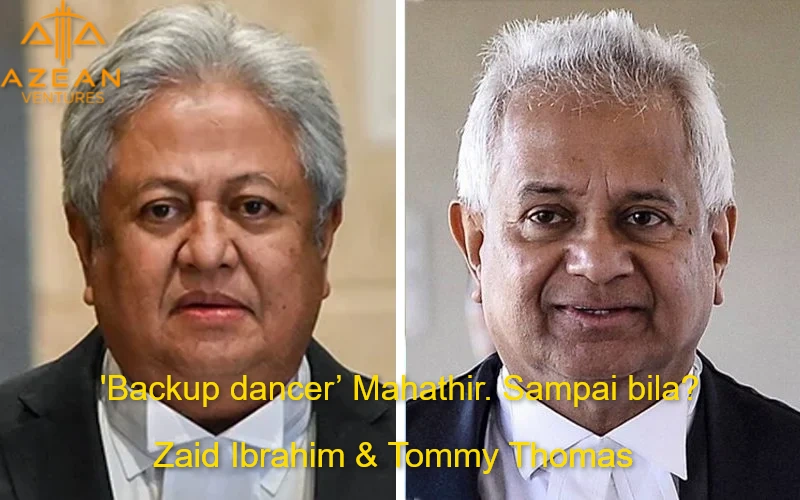
Tommy Thomas dan Zaid Ibrahim — dua veteran yang patutnya tenang minum kopi — tiba-tiba muncul dengan kritikan kosong – seolah-olah baca WhatsApp forward saja.
Tommy dusts off his grievances, Zaid adds his trademark drama, and Mahathir’s elderly influencer brigade attempts yet another comeback tour nobody asked for. They have launched – the Manufactured Outrage Program.
The US-Malaysia Agreement On Reciprocal Trade (ART)
Mahathir, Tommy Thomas dan Zaid Ibrahim – Bising je, Isi Tak Ada.
The Anti-ART Drama Malaysia Didn’t Ask For.
The Americans have a phrase for it: “political noise without political substance.” Malaysia is now experiencing its own version—and front and centre are two familiar figures, Tommy Thomas and Zaid Ibrahim. Both have taken aim at the ART pact with great enthusiasm, but with all the depth of a TikTok rant. For two senior lawyers, their complete refusal to quote actual clauses, list actual risks, or present actual alternatives is bizarre.
At this point, even average Malaysians are asking: “Dah baca ke belum sebenarnya… atau just hentam saja?” Kalau belum baca – ha – ini dia –
This entire episode smells less like principled legal concern and more like a political hit job coordinated through a familiar playbook — one perfected by Mahathir Mohamad over decades.
The “Sovereignty Lost” Narrative Is Completely Unsupported by the Text.
Let’s be clear: The ART is a trade agreement. Not a governance treaty. Not a political-integration pact. Not a security alliance.
It sets tariff rules. Investment rules. Market-access rules. It does not touch:
Malaysia’s Constitution
Article 153
citizenship laws
land ownership rules
religion, culture, education
elections or political structures
internal security or policing
Claiming otherwise is either a sign of not having read it — or a deliberate political misrepresentation.
Article 5 Does NOT Give America Control — And Both Tommy and Zaid Know It.
Tommy Thomas has insinuated that Article 5 hands the U.S. leverage over Malaysia’s ability to regulate.
Except… it doesn’t.
Article 5 is a coordination mechanism, not a control mechanism. It says Malaysia will consult and will facilitate the smooth application of standards within its domestic law.
Within it’s
Domestic
Law.
In other words: Malaysia decides. Malaysia enforces. Malaysia retains jurisdiction.
Which senior lawyer doesn’t know the difference between “consult” and “comply under foreign command”? — Unless politics has conveniently clouded the distinction.
The Critics Never Mention Article 7 — Because It Completely Dismantles Their Argument.
Why? Because Article 7 is a sovereignty fortress.
7.1 Recognition of Existing Rights & Obligations.
The ART explicitly acknowledges Malaysia’s right to maintain and apply its existing legal and regulatory framework.
This alone destroys the “we lost control” claim.
7.3 Amendments Only by Mutual Consent.
Nothing can be changed unless Malaysia agrees. If Malaysia does not agree, nothing moves. End of story.
7.4 — Domestic Law Takes Priority.
This is the one Tommy and Zaid conveniently avoid discussing.
“Nothing in this Agreement shall constrain… a Party from imposing additional tariffs… or measures for national security or economic protection, consistent with its domestic law.”
Translation:
Malaysia can do whatever it needs — from tariffs to safeguards — as long as it follows Malaysian law.
This is the opposite of surrender. It is sovereignty cast in stone.
7.5 — The Exit Clause.
Malaysia can withdraw at any time with written notice. A country that can walk away is not controlled.
Why won’t Tommy and Zaid discuss Article 7? Because it directly contradicts the story they’re trying to sell.
The Old Mahathir Tactics: Stoke fear.
Let’s call this what it is. This isn’t legal analysis. This is political positioning.
The pattern is painfully familiar — the same tactic used by politicians in other countries when they want to attack leadership:
Ignore the actual content.
Stoke fear.
Position the government as weak.
Repeat it loudly and often enough to create doubt.
It is the Malaysian version of the American “orange man bad” reflex:
If Trump did it, it must be wrong — therefore let’s discredit it even if it benefits the nation.
Tommy and Zaid are doing the Malaysian variant:
If Anwar and Zafrul negotiated it, it must be dangerous — so let’s call it a surrender.
This isn’t legal reasoning. It’s political theater dressed in legal robes.
The ART is arguably the strongest multilateral trade win Malaysia has secured in 40 years. It expands market access across ASEAN, strengthens regional supply chains, and finally positions Malaysia to benefit from the post-China realignment that global manufacturers have been quietly planning for years.
And yet here we are—being lectured by people who have prioritized politics over the interests of the nation. They stand in front of cameras proclaiming the trade pact “dangerous” and “harmful,” without the courtesy of explaining why.
Macam biasa lah—serang je, Rakyat takkan baca – diorang bodoh!
Tommy & Zaid: Big Titles, Small Arguments.
Tommy Thomas is not an amateur. Neither is Zaid Ibrahim. Both are seasoned lawyers. Both were in government. Both understand treaties. Both know how to break down clauses.
So why haven’t they? Why are Malaysians only hearing sweeping statements like “this is bad for sovereignty” or “this threatens Malaysia’s autonomy,” without one single legal breakdown?
Because if they actually listed the clauses, the public would realise the opposite: the ART protects Malaysia, not endanger it.
It’s telling that neither of them has produced:
A clause-by-clause analysis.
A legal memo.
A risk assessment.
A proposed amendment.
Nothing.
Just alarmist slogans.
“Bising bukan main, tapi fakta satu pun tak keluar.”
Their silence on specifics is louder than their outrage.
ART Is Good for Malaysia—Which Is Why They’re Attacking It.
Let’s be honest: If the ART was flawed, these two would have written a 20-page condemnation by now. But they haven’t—because the treaty is solid.
Three things stand out clearly:
Malaysia gains expanded export access without giving up regulatory control.
We secure priority in ASEAN’s reconfigured supply chains as global firms diversify away from China.
We finally anchor ourselves in a regional financial ecosystem that reduces dependency on external volatility.
The Reality: ART Is the Most Transformative Boost to Malaysia’s Trade Power in 40 Years.
Here’s what the ART actually does — none of which Tommy or Zaid have bothered to explain:
It removes structural barriers that have crippled Malaysia’s international competitiveness.
Foreign investors, especially U.S. firms, finally get:
clarity
predictability
non-discriminatory treatment
stability
protection against arbitrary rules
This is exactly what serious economies (Singapore, South Korea, Japan) built their success on.
It sharply enhances Malaysia’s credibility with global capital markets.
A U.S. reciprocal agreement is a signal to world markets that Malaysia is:
stable
rules-driven
investable
geopolitically aligned with major trade partners
This is worth billions in future FDI.
It removes the most problematic NEP-era barriers specifically for the business sector.
Not constitutional rights.
Not social policies.
Not Malay privileges in education or cultural matters.
But rather:
equity caps
local-ownership mandates
selective licensing
procurement discrimination
approvals that were often opaque and discretionary
These were the exact policies that drove Grab, Carsome and dozens of Malaysian-born companies to Singapore.
The ART dismantles those barriers — in phases — in a way that helps Malaysia, not harms it.
It puts Malaysia ahead of ASEAN neighbours in securing U.S. trade guarantees.
This is not a small achievement. This is a generational one.
And yet… Tommy and Zaid want Malaysians to treat it like a national humiliation.
This is the kind of long-term economic security Malaysia has never had. Which explains why the usual political war room in The Mines lit up like a Christmas tree. Someone has pressed the “panic” button.
Because a strong, reform-oriented Malaysia is the last thing Mahathir’s political network wants. Their strategy depends on instability, confusion, and perpetual dissatisfaction.
Put simply:
Kalau Malaysia maju, kami rugi.
The Real Target Is Not the ART — It’s Anwar Ibrahim.
The pushback against the ART is not about Bumiputra rights. It is about politics disguised as legal concern. What Tommy and Zaid are really defending is not sovereignty. It’s the political utility of fear.
They are tapping into the old Mahathir-era narrative that any opening of Malaysia’s economy is somehow a threat to Malay survival — a narrative built on decades of political conditioning, not constitutional reality.
And just like the Democrats’ obsession with “orange man bad” in the US—where even good policies are condemned simply because Donald Trump’s fingerprints are on them—Malaysia now has its own version:
“Asal Anwar buat, mesti salah.”
That is exactly what is happening with the ART.
Tommy and Zaid may have different styles but both have aligned themselves with Mahathir with the same political objective: undermine Anwar, not analyze the treaty. We are watching a bunch of old timers, 2 former legal heavyweights and a former Prime Minister trying to derail this government just like Mahathir has done for the last 25 years derailing every government he doesn’t control.
Malaysia becomes collateral damage.
Malaysia Deserves Better Than This Manufactured Panic.
The ART is not perfect. No treaty is. But it is unquestionably one of the best trade arrangements Malaysia has ever secured. To sabotage it because of politics is not just irresponsible—it is self-destructive.
Malaysia faces a simple choice: Follow the facts, or follow the fear.
One path modernizes the economy, attracts investment, strengthens institutions, and expands prosperity for all communities — including Bumiputra Malays who gain from better jobs, better wages, and a more competitive national economy.
The other path leads back to the same stagnant, defensive politics that has held Malaysia back since the 1980s.
Tommy Thomas and Zaid Ibrahim may prefer the second path.
Malaysia shouldn’t.