Something is shifting in Malaysia – and this time, it feels different.
As Johor and Negeri Sembilan head into crucial state elections, there is a growing sense that the ground beneath the political establishment is beginning to crack. The ruling coalition, Pakatan Harapan (PH), is bracing for impact. The expectation across political observers is not just losses – but significant losses.
And into that vacuum, a new force is rising.
BERSAMA, led by Rafizi Ramli and Nik Nazmi, is no longer being dismissed as a fringe experiment or a temporary protest movement. The crowds at recent rallies tell a different story. The energy is real. The momentum is building. More importantly, the message is landing.
Because this is no longer about ideology. It is about trust.
Pakatan Harapan – A Total And Complete Betrayal.
Across the board – from UMNO to PAS, from Perikatan Nasional to Pakatan Harapan – the old political machinery is struggling to connect. Social media campaigns are being rolled out, narratives are being crafted, attacks are being coordinated. But the rakyat is not responding the way they used to.
The reason is simple. They’ve heard it all before.
Malaysia is not unique in this regard. Across Europe, in the United Kingdom, and beyond, electorates are turning on political establishments that have over-promised and under-delivered. Leaders campaign on bold reform, systemic change and moral clarity – only to retreat into political survival once in power.
Malaysia is now part of that global pattern.
And at the centre of this growing disillusionment is Prime Minister Anwar Ibrahim. Across the country, the sentiment is no longer just frustration – it is betrayal. The Reformasi agenda that defined Anwar’s rise has, in the eyes of many, been abandoned. What Malaysians were promised as deep structural reform has yet to even meaningfully begin. Was REFORMASI ever anything more than a political slogan?
This is not a personal attack. It is a political reality. Before GE15, Anwar’s platform was built on structural reform – not small tweaks, but sweeping changes that spoke directly to the frustrations of ordinary Malaysians. It was a message of renewal, of integrity, of doing things differently.
REFORMASI – Nothing More Than A Hollow Political Slogan.
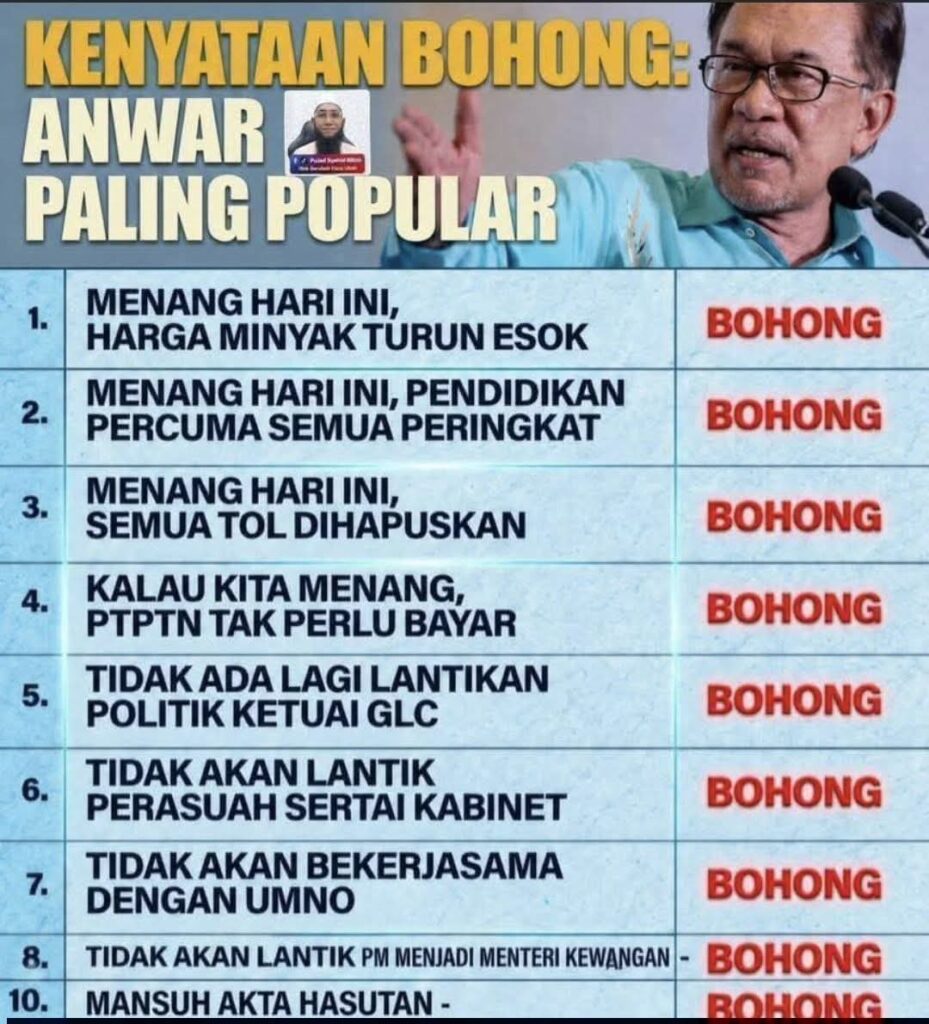
But today, that promise rings hollow. Consider some of what was pledged.
Free education up to university level — a transformative policy that would have redefined opportunity for an entire generation. It has not materialized.
The abolition of highway tolls — a long-standing burden on everyday Malaysians. Tolls are still in place.
The waiving of PTPTN student loans — a powerful signal to young voters struggling under financial pressure. Unfulfilled.
An end to political appointments in government-linked companies (GLCs) — a commitment to meritocracy and governance reform. Quietly ignored.
A firm stance against corruption — no individuals facing serious charges would be appointed to Cabinet. And yet, Zahid Hamidi was made Deputy Prime Minister while facing dozens of charges linked to corruption.
A leaner, more efficient Cabinet — a promise to reduce excess and improve governance. Instead, Malaysia now has one of the largest Cabinets in the region.
And perhaps most significantly, a clear assurance that there would be no political cooperation with UMNO. That promise lasted exactly as long as it took to form a government.
This is not about political compromise – voters understand that coalition-building is part of governance. This is about credibility. When red lines are drawn so clearly during a campaign, only to be erased immediately after, it sends a message.
And the rakyat has received it.
The Rise Of BERSAMA.
The growing support for BERSAMA is not simply because it offers something new. It is because it represents a rejection of what has come before.
A rejection of recycled promises. A rejection of transactional politics. A rejection of a system where manifestos are treated as suggestions rather than commitments.
What Rafizi and his team appear to understand – and what many others still do not – is that Malaysians are no longer asking for perfection. They are asking for honesty, accountability and follow-through.
That is a much lower bar. And yet, it continues to be missed.
UMNO, PAS, and Perikatan Nasional are facing the same problem. Their attempts to regain momentum have been met with indifference at best, and scepticism at worst. The old narratives are no longer persuasive. The old playbooks are no longer effective.Because this is not just a political contest. It is a credibility crisis.
Sadly, the incumbent political class do not see this.
Pakatan Harapan Lost Their Chance.
The Johor and Negeri Sembilan elections may well be the clearest signal yet of where the country is heading. If the projected losses for PH materialise, it will not just be a setback – it will be a warning shot ahead of GE16.A message that cannot be spun, reframed or managed away.
The rakyat is watching. And more importantly, the rakyat is remembering.
In politics, momentum can build slowly – and then shift suddenly. What we may be witnessing now is the early stage of that shift. A transition from entrenched dominance to open contest. From predictable outcomes to genuine uncertainty.
For decades, Malaysian politics has operated within defined boundaries. The players changed, the coalitions shifted, but the underlying dynamics remained largely intact.
That may no longer be the case.
BERSAMA’s rise suggests that space has opened up for something different – not just another party, but another approach. Whether it can sustain that momentum is another question entirely. Political enthusiasm is one thing; electoral machinery is another. Translating crowd energy into votes requires organisation, discipline and strategy.
But one thing is clear. The appetite for change is real. And it is growing.
The Rakyat Want Real Change – That PMX Refuses to Deliver.
For Anwar Ibrahim and the current government, the challenge is no longer about messaging. It is about delivery. The window for goodwill has narrowed significantly. The tolerance for unfulfilled promises has all but disappeared.
For the opposition, the challenge is even more fundamental. Reinvention is no longer optional – it is necessary. Because the Malaysian voter of today is not the same as the voter of a decade ago.
More informed. More connected. More sceptical. And far less forgiving.
The coming elections will not just determine control of two states. They will offer a glimpse into the future of Malaysian politics. A future where loyalty is no longer assumed. Where credibility matters more than rhetoric. And where, finally, the rakyat may begin to reclaim the power that has too often been taken for granted.
If that is indeed the direction Malaysia is heading, then Johor and Negeri Sembilan may be remembered not just as state elections. But as the beginning of a political reset.