

International Tax Residence Guide for Founders
An international tax residence guide for founders: assess physical presence, personal ties, treaty claims and Malaysian planning before you relocate.
Malaysia is famous for many things: good food, friendly people, beautiful beaches, and the amazing ability of our citizens to complain about politics while eating nasi lemak at 2 a.m. Although Malaysia has long been praised as a “harmonious” multi-racial nation, the truth is far less comforting. Much of this so-called unity is really just quiet tolerance — a polite, weary accommodation by non-Malays who see no peaceful or pragmatic way out of the political system built around them. Beneath the smiles and festival greetings lies a deep reservoir of frustration, resentment, and, in some communities, something edging dangerously close to hatred — the predictable outcome of decades of race-based engineering.
But for all our multicultural charm, critics say that the country we know today did not become divided by accident. It was shaped by political leaders who discovered long ago that race and religion were not just sensitive topics — they were powerful tools for political power.
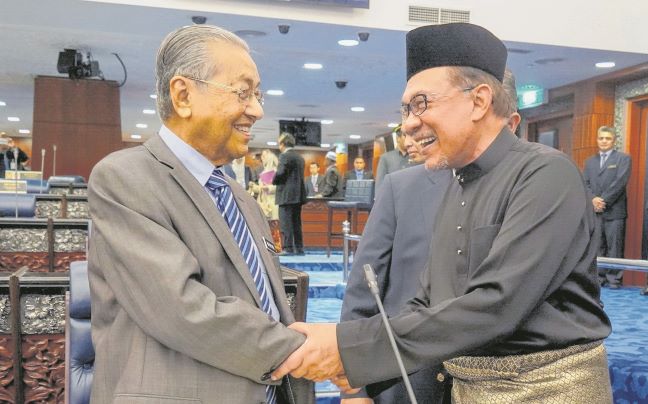
Two names stand out: Mahathir Mohamad and Anwar Ibrahim. Between the two of them, they helped build a political system where identity — not ideas — became the main ingredient of Malaysian politics.
Whether you admire him or cannot stand him, no one can deny that Mahathir is one of the most influential political figures in Malaysia’s history. When he first took office in 1981, many Malaysians hoped he would modernize the economy and strengthen national unity. And yes, he did modernize parts of Malaysia. But critics argue that he also did something else — something far more lasting.
He made race the main organising principle of Malaysian politics.
Let’s address the elephant in the room — or should we say, the Indian elephant in the political room?
In 2024, Mahathir himself told the court:
“I’m not ashamed to say I have some Indian blood, but I’m Malay.”
This was widely reported, along with his explanation that under the Constitution, he qualifies as a Malay because he speaks Malay, practices Malay customs and is a Muslim. Nothing wrong with that — every Malaysian family tree is more complicated than an RTM ”Drama Minggu Ini”. But here’s the point critics make: a man who openly acknowledged his mixed heritage spent decades pushing a political agenda based heavily on “Malay rights first”.
By Mahathir’s definition, every Bangladeshi and Pakistani migrant working the night shift at the local mamak could qualify as Malay by next Friday. In fact, if speaking Malay and going for Friday prayers is all it takes, half of Kuala Lumpur’s construction workforce would suddenly outrank UMNO Supreme Council members in “Malayness.” It’s a wonderfully flexible definition — elastic enough to suit political necessity, but somehow never flexible enough to include Malaysians who have been here for generations and actually need protection or opportunity.
Once in power, Mahathir moved fast. Critics say he reshaped the civil service into a Malay-dominated institution. This was framed as “restoring balance” — but the results were far more extreme:
Promotions favoured Malays.
Government departments became overwhelmingly Malay.
Non-Malays increasingly felt like visitors in their own public institutions.
If Malaysia were a company, HR would have been sued.
The message promoted throughout his government was simple:
To be patriotic is to accept Malay-first policies.
Not temporary, not negotiable, not up for discussion. More like a permanent “house rule”, the kind your grandmother gives you — if you don’t follow it, don’t bother coming home for dinner.
Critics argue that Mahathir’s policies gradually changed Malaysian society in several ways:
Race became the main filter for government decisions.
The idea of a ‘Malaysian identity’ became weak.
Suspicion grew between groups.
Meritocracy took a long holiday.
This wasn’t the Malaysia our grandparents talked about.
Sadly, the majority of Malays bought into this racially-charged election talk because it was marketed as a fast-track to success — almost like a political version of “Buy 1 Free 1” for opportunities. But here’s the cruel twist: only a tiny group of elites and cronies ever enjoyed the real benefits. And the biggest irony? A large number of these beneficiaries were not Malay at all. The ones who truly cashed out were the Lim Goh Tongs, the Ananda Krishnans, the Tan Sri Arumugams, the Yeoh Tiong Lays — plus Mahathir’s children and their well-connected friends. Together, they formed the “exclusive club” at the top, while most ordinary Malays received just enough crumbs to keep them believing the system was working for them.
Part 2 will dig deeper into how this happened — and how Malays were cleverly kept in the dark while others quietly took the cake.
If Mahathir’s political weapon was race, Anwar’s early political weapon was religion.
Before he became the hero of “Reformasi”, Anwar was the president of ABIM, a Muslim youth movement that wanted the country to become more Islamic in public life. He was charismatic, passionate, and persuasive — the kind of student leader who could convince you to attend a seminar at 8 a.m. on a Saturday.
When Mahathir invited Anwar into UMNO, he brought with him a wave of Islamic enthusiasm that swept through universities, ministries and policymaking.
Critics argue that this contributed to the Islamisation of Malaysia:
stronger religious institutions.
more conservative public policies.
and the merger of political identity with religious identity.
And then there’s Project IC — the alleged granting of identity cards to non-citizens in Sabah to shift the state’s voting demographics.
Anwar denies involvement; the issue is complicated. But critics say that if the allegations are true, Project IC would be one of the boldest political “population engineering” projects in Southeast Asia — permanently altering Sabah’s culture and political landscape.
The fact that many Malaysians even believe such a scheme was possible reflects how deeply identity-based politics had become part of the system.
By the time the 2000s rolled around, Malaysia had become a country where:
In other words: Malaysia didn’t just have identity politics — it was built on identity politics.
Malaysia once had the ingredients to be a true global model of multicultural success. But our political leaders turned our diversity into a political weapon — because fear, not unity, is what wins elections.
To rebuild unity, we need to be bold. We need to imagine a Malaysia where every citizen — regardless of race or religion — feels like they belong without needing to “qualify”.
That doesn’t mean abandoning Malay rights or ignoring Islam. It simply means building a Malaysia where fairness is not seen as a threat.
Yes, it’s a big dream. But Malaysians are dreamers — after all, we still believe the LRT will someday arrive on time.
An international tax residence guide for founders: assess physical presence, personal ties, treaty claims and Malaysian planning before you relocate.

Labuan Company vs Malaysian Sdn Bhd: Which Structure Fits an International Entrepreneur? By: Damian Fernandez © 21st Sept. 2026 For an international entrepreneur looking at

Build an asset protection company structure for ASEAN growth, cross-border banking, privacy and compliant long-term mobility in Malaysia with confidence.
Labuan substance rules determine whether your company can retain its tax position. See what genuine activity, staffing and records require on site now.

Offshore banking versus fintech: compare control, compliance, access and resilience when structuring your business for ASEAN growth and global mobility.
Learn how to outsource ASEAN payroll remotely with compliant local processes, dependable reporting and a structure built for regional growth at scale.
We use cookies to improve your experience on our site. By using our site, you consent to cookies.
Manage your cookie preferences below:
Essential cookies enable basic functions and are necessary for the proper function of the website.
You can find more information in our Cookie Policy and Privacy Policy.