
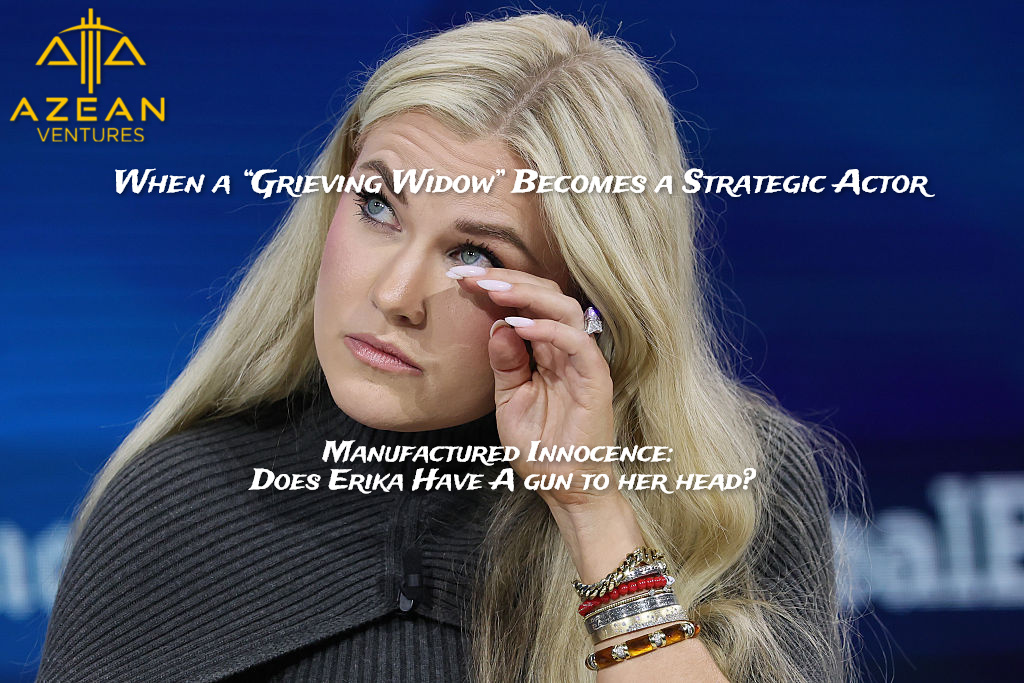
Let’s be clear about something first. Erika Kirk is not some naïve figure being dragged along by events. She is educated, a devout Christian, a capable woman — and above all, a mother who has just lost her husband. To suggest she had any role in her husband’s killing is not just wrong, it is grotesque. What is far more plausible is something painfully human: in the aftermath of unimaginable loss, she had to think about survival, safety, and the future of her children.
Grief does not erase responsibility. Choosing stability over confrontation, and silence for the sake of security, does not make her complicit — it makes her a pragmatic parent doing what parents have always done: protect what remains. With that human reality acknowledged, we can now examine the public role Erika has stepped into. Candace might say that the Egyptians have the proverbial “gun to Erika’s head”. And no one should be surprised if Erika was encouraged by the White House to make a deal; while simultaneosly spurring Candace to ask the uncomfortable questions.
Millions of ordinary people — not “analysts,” not “conspiracy theorists” — are noticing the same things.
First, the story closed too fast.
Then questions were discouraged.
Then one voice was attacked for refusing silence.
Then another voice was elevated to restore order.
That sequence matters. You don’t need secret files to see it. You don’t need insider access. You just need to watch who benefits from silence and who pays the price for speaking.
This is the first red flag people keep coming back to.
Erika Kirk has spoken publicly about forgiveness, grace, and even understanding toward the man authorities say killed her husband.
Yet, that same grace disappears completely when it comes to Candace Owens — a woman who is not accused of harming anyone, but who is simply asking questions about what happened. That contrast is jarring.
Most people can understand forgiveness toward an attacker as a personal, faith-based choice. What they don’t understand is this:
Why is the deepest anger reserved not for the person who pulled the trigger — but for the person asking how and why it happened?
Because Candace could jeopardize whatever fragile assurances now exist around her safety and the future of her children. You don’t need to believe in shadowy plots to understand this. You only need to understand parental instinct. Candace Owens is no longer just a commentator asking uncomfortable questions; she becomes a perceived risk
Erika has publicly told Candace Owens to stop questioning her husband’s death. Just: Stop. That tone matters. The expression in her eyes matters. This is when the pretence ends. Erika wants the truth to go public. What wife wouldn’t?
This is no longer about one commentator.
It is no longer about one widow.
It is no longer about one tragic death.
It is about who gets to ask questions; and who is desperate to shut them down; and who does it serve to shut it down?!
When the wife of the victim tells the public to stop asking questions — especially in a high-profile killing — it doesn’t feel like grief. It feels like closure being enforced; and it is usually driven by fear.
One hypothesis increasingly voiced by ordinary people is that fear, not indifference, explains Erika’s position. The quiet, parental fear that comes when safety feels conditional and stability feels fragile. From that angle, calls to stop asking questions look more like self-preservation. Candace Owens appears to be operating from the opposite instinct — that sunlight, not silence, offers the best long-term protection, and that exposing truth dismantles threats rather than inviting them. Against this backdrop, Dan Bongino’s sudden resignation from FBI leadership inevitably raises eyebrows. It may mean nothing. But in moments like this, people notice timing — especially when questions are being discouraged.
When two women are pulled into opposite roles — one to ask questions, one to end them — it means the truth is not settled. It is being managed.
And managed truth is never the whole truth and nothing but the truth.
Another source of skepticism is simple common sense. Charlie Kirk was not an obscure figure. He was influential, high-profile and controversial.
When people are told that a single 22-year-old acted entirely alone, with no deeper context, no warning signs, no unanswered connections — many simply don’t buy it.
After a long private meeting, both Erika Kirk and Candace Owens agree on one thing: there is no concrete proof tying the alleged shooter to Charlie Kirk’s death. If the case were truly closed, why does it still feel unfinished? Not because they “know the truth,” but because the explanation feels too thin for the impact. When the story doesn’t match the scale of the event, people instinctively ask more questions.
That’s human nature.
This may be the biggest issue of all. For years, Charlie Kirk’s public voice was unmistakable:
Jesus Christ, The Gospel, Salvation, Spiritual warfare, Western Christian civilization
Love him or hate him, no one doubted what he believed or preached. And yet the message now being presented as his final legacy is something very different. The book released after his death does not center on Christ, redemption, or salvation through Jesus. Instead, it emphasizes observing the Sabbath in the traditional Jewish sense as the key to spiritual transformation.
That shift is enormous.
They are reacting because this does not sound like the Charlie they listened to for years. When a public figure’s message suddenly changes after death — and that change is promoted heavily by those managing the legacy — people are right to ask:
Was this really his focus? Was this really his final priority?
Or is something being reframed?
Those questions are not hateful. They are reasonable.
Candace Owens represents something simple — and dangerous to power:
The refusal to move on just because you’re told to. She doesn’t claim to have final answers. She doesn’t declare the case closed. She keeps asking what ordinary people ask when something doesn’t sit right. And for that, she absorbs heat.
That tells you her questions matter.
That’s why Erika is no longer being viewed only as a grieving widow by a large part of the public. Not because people lack compassion — but because she has stepped into an active role shaping the narrative.
Once someone does that, scrutiny follows. That’s not cruelty. That’s accountability.
This post is not asking you to pick Candace over Erika. Or Erika over Candace. That’s the trap that has been set by the real evildoers. This is about recognizing roles.
Pressure and counter-pressure. Siege and counterweight. Question and shutdown.
Once you see the roles, you can’t unsee them.
At the heart of all this is one simple question ordinary people keep asking:
Why would anyone want to shut down honest questions about who killed their husband? Until that question is answered clearly, calmly, and transparently — the skepticism will not go away. You are not being asked to “believe” anything. You are being asked to pay attention.
Silence won’t fix it. Anger won’t fix it. Telling people to stop won’t fix it.
Only clarity will.
And that, more than anything else, is why people keep saying:
Something isn’t right.