
International Tax Residence Guide for Founders
An international tax residence guide for founders: assess physical presence, personal ties, treaty claims and Malaysian planning before you relocate.

Mahathir’s ever-expanding army of influencers is scrambling to eject yet another sitting prime minister — and Tommy now looks like the latest recruit. Malaysians can’t help asking: is this about national interest, or someone’s next big legal payday?
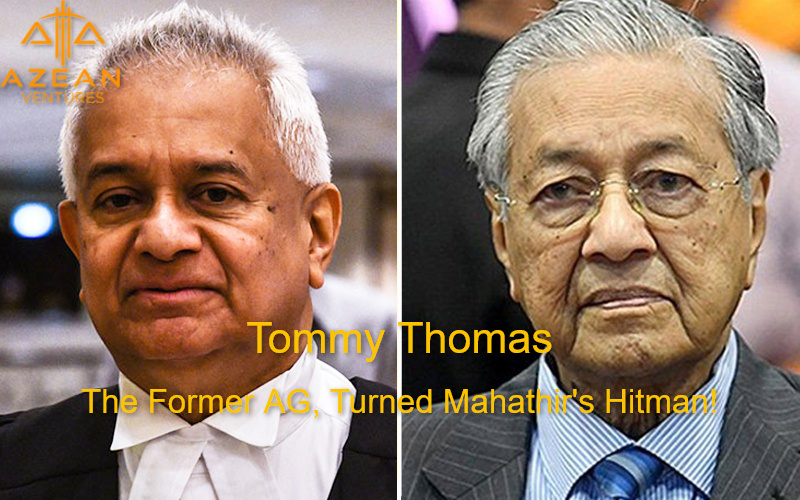
Former Attorney General Tommy Thomas has unleashed an alarmist critique — this time declaring Malaysia’s new US trade agreement “the worst since Merdeka”. It is a dramatic claim. It is also an intellectually lazy one, devoid of evidence, policy substance, or even basic geopolitical awareness.
The problem is not that Tommy disagrees with the agreement. Reasonable people can and should debate major policy shifts. The problem is that Tommy did not critique the deal — he merely attacked it, relying on sweeping, sensationalist statements rather than offering a single workable alternative.
For a man who once held the highest legal office in the country, his intervention is astonishingly unserious.
And it exposes something far more troubling: this is not a legal argument, not an economic analysis, and certainly not a geopolitical critique.
This is a political hit piece, thinly veiled as expert commentary — a grenade lobbed at Anwar Ibrahim and Tengku Zafrul, likely at the behest of parties whose relevance depends on Malaysia remaining weak, inward-looking, and diplomatically paralysed.
Tommy confidently declares that those negotiating the trade deal — including the Attorney-General’s Chambers — “did not negotiate at all”.
He has zero knowledge of the original draft, the negotiation rounds, or which clauses Malaysia pushed back on. To claim that the negotiators “did not negotiate at all” is not merely pathetic — it is irresponsible.
It is character assassination dressed up as analysis.
A former Attorney General should know better. He should know that treaty negotiation is always continual, or iterative and that the text seen by the public represents the end of a long process of refinement, rejection, redrafting, and compromise.
His accusation is the rhetorical equivalent of shouting “this durian is lousy lor!” without opening it, smelling it, or even knowing which stall it came from — pure kopitiam drama, zero substance.
If Tommy believes the negotiators failed, he should specify:
Which clauses show failure and why?
What should Malaysia have demanded?
Which terms should be renegotiated or how they can be redrafted?
What alternative structure would protect sovereignty?
He offered none of this. For a man who spent his career claiming the intellectual high ground, this is embarrassingly shallow.
Tommy insists the deal is “undoubtedly” the worst agreement Malaysia has signed since independence. “Undoubtedly” is a convenient word when one offers no proof, no comparison, and no legal reasoning.
If the agreement is so disastrous:
Which article violates sovereignty?
Which provision undermines legal autonomy?
Which term creates unacceptable economic dependency?
Which clause contradicts Malaysia’s Constitution or treaties?
Again — he offers nothing of substance – merely flailing arms and emotion: “worst since Merdeka”. This is not analysis. It is political theatre, performed for a specific audience and purpose.
And the irony is glaring: Tommy Thomas, who once defended some of the most controversial executive decisions in modern Malaysian history, now pretends to be the guardian of national sovereignty.
Tommy claims that before 2022, every Prime Minister kept the US at arm’s length.
That may be true.
But the real question is: Has this strategy benefited Malaysia?
Let’s examine the results of Malaysia’s supposedly “independent” posture:
Foreign investors bypassed Malaysia for Vietnam and Singapore.
Malaysia’s manufacturing competitiveness eroded.
The ringgit became one of Asia’s weakest currencies.
High-tech supply chains skipped Malaysia almost entirely.
Malaysia missed out on hundreds of billions in global capital flows.
Meanwhile, Vietnam — which embraced US economic engagement — is booming. Singapore — which openly partners with the US — is the region’s financial capital. Even Thailand and Indonesia have aggressively courted American tech and investment.
So Tommy’s argument is essentially:
“Let’s keep doing the thing that has failed Malaysia for 50 years.”
This is not strategic thinking. This is theatrical nostalgia masquerading as policy.
This is the most reckless part of his argument. Tommy demands that Malaysia abandon the deal “as soon as possible”, using an escape clause.
But he conveniently ignores the consequences:
Malaysia loses 0% tariffs on 1,400–1,700 products, crushing exporters.
The US pivot to ASEAN bypasses Malaysia entirely.
The GenAI and GPU build-out moves to Thailand, Vietnam, or Singapore.
Nvidia’s Malaysian anchor investment loses strategic support.
The US rewiring of Indo-Pacific supply chains excludes Malaysia.
Malaysia signals to global markets it is unreliable and erratic.
This would be economic suicide. And Tommy offers no replacement:
Should Malaysia seek a better deal?
He does not say.
Should Malaysia renegotiate terms?
He does not suggest how.
Should Malaysia propose amendments?
He offers no draft, no clause, no model.
It is pure destruction without reconstruction.
Even more astounding:
He suggests the deal be put to a vote in Parliament — where it will almost certainly pass. Why would any serious lawyer recommend a theatrical vote that undermines the executive, damages investor confidence, and yields the same outcome?
Unless, of course, the real goal is not to scrutinise the agreement…
…but to weaken the Prime Minister.
The fingerprints all over this hit piece are obvious. Mahathir Mohammed has been desperate to break the emerging Anwar–Zafrul technocratic axis, terrified of losing control over Malaysia’s geopolitical orientation.
Tommy’s article reads less like a legal analysis and more like a continuation of Mahathir’s lifelong reflex:
Sabotage every leader who refuses to follow his outdated view of the world.
Tommy fits neatly into Mahathir’s pattern of using “intellectuals” to undermine sitting governments:
Musa Hitam
Abdullah Badawi
Najib
Muhyiddin
And now Anwar
Every Prime Minister who attempted to modernise Malaysia was accused of “selling out sovereignty”. Every attempt to integrate Malaysia into the global economy was labelled “foreign interference”. It is a script older than Merdeka itself.
There are plenty of legitimate reasons to remove Anwar Ibrahim from office. He has failed to deliver the reformist agenda he shouted from every ceramah stage. Institutional reform? Stalled. Anti-corruption independence? Compromised. Separation of powers and a stronger Parliament? Quietly shelved. Even his campaign promise to dismantle political cronyism has blurred into the same old patronage politics. Whether these failures stem from promises he never intended to keep, or from fear of Mahathir’s revived “Malays First” pressure campaign, the result is the same: reform has flatlined.
But none of this justifies Tommy Thomas carrying Mahathir’s water bottle by torpedoing a trade agreement that could re-launch Malaysia onto the global stage. True patriots don’t try to damage the nation simply to damage a leader. They weigh the positives, identify the risks, and push for improvements — not sabotage. Thomas isn’t offering solutions; he’s offering a political hit job dressed up as legal commentary.
If Tommy wanted to be constructive — which he clearly did not — he would have focused on:
And what edits would fix them?
Should there be a carve-out for judicial review?
Where is the risk, and where is the opportunity?
With Nvidia expanding in Malaysia, the trade deal gives U.S. tech firms greater confidence to base long-term AI infrastructure here. This positions Malaysia as ASEAN’s default GPU hub, attracting more data centres, training clusters, and high-value digital jobs.
As U.S.–China decoupling accelerates, Malaysia can use the agreement to lock in “friendshored” manufacturing and logistics routes. This means more factories, component assembly, and regional distribution lines relocated from China to Malaysian soil.
The trade deal enables Malaysia to experiment with dollar-backed stablecoin settlement for cross-border trade—offering faster, cheaper and more transparent transactions without sacrificing monetary sovereignty. It also signals compliance with U.S. financial standards, reducing geopolitical risk.
By aligning with U.S. digital trade norms, Malaysia can modernise customs, documentation, and settlement processes into a blockchain-compatible, real-time system. This cuts red tape and makes Malaysia a preferred gateway for U.S.–ASEAN commerce.
Closer financial interoperability with the U.S. gives Malaysia a buffer against regional currency shocks and BRICS de-dollarisation experiments. It allows Malaysia to enjoy dollar liquidity without political subservience — stability without surrender.
He did not offer even a sentence.
Silence.
No suggestion.
In other words:
Tommy Thomas has not made a serious challenge. He has made a political accusation.
While Tommy romanticises “sovereignty”, the world is moving.
The US is rewiring global finance through the GENIUS Act.
BlackRock is digitising the financial plumbing of the world.
Nvidia is anchoring AI superclusters.
ASEAN is becoming the geopolitical pivot of the Indo-Pacific.
And Malaysia has three extraordinary advantages:
A unique ability to work with both Washington and Beijing.
A central role in semiconductor, EV, and digital infrastructure supply chains.
The personal involvement of Jensen Huang — arguably the most influential technologist alive — who has chosen Malaysia as a regional base.
No other ASEAN nation has this alignment of political neutrality, strategic geography, and deepening ties to US digital power.
Tommy Thomas wants Malaysia to walk away from this — with no plan, no replacement, and no strategy. It is the most dangerously naive suggestion made by a senior Malaysian public figure – since Merdeka!
Tommy Thomas’ article is not an act of patriotism. Nor is it legal analysis.
It is a political weapon, aimed squarely at Anwar Ibrahim, carrying the unmistakable scent of Mahathir-era destabilization tactics.
It pretends to defend sovereignty while actively undermining Malaysia’s economic future. It claims to uphold dignity while offering no solution, no negotiation path, and no alternative deal. It accuses others of not negotiating — while not proposing a single negotiation strategy himself.
Malaysia deserves a real debate — not theatrics, not nostalgia, and not political sabotage dressed as constitutional guardianship.
The real question for Malaysians is simple:
Do we want to cling to the past, or negotiate our place in the future?
Tommy has made his choice.
Malaysia must make a better one.
An international tax residence guide for founders: assess physical presence, personal ties, treaty claims and Malaysian planning before you relocate.

Labuan Company vs Malaysian Sdn Bhd: Which Structure Fits an International Entrepreneur? By: Damian Fernandez © 21st Sept. 2026 For an international entrepreneur looking at

Build an asset protection company structure for ASEAN growth, cross-border banking, privacy and compliant long-term mobility in Malaysia with confidence.

Labuan substance rules determine whether your company can retain its tax position. See what genuine activity, staffing and records require on site now.

Offshore banking versus fintech: compare control, compliance, access and resilience when structuring your business for ASEAN growth and global mobility.
Learn how to outsource ASEAN payroll remotely with compliant local processes, dependable reporting and a structure built for regional growth at scale.