By: Damian Fernandez
Why the Insurrection Act Is Unlikely — and Where Accountability Really Lies.
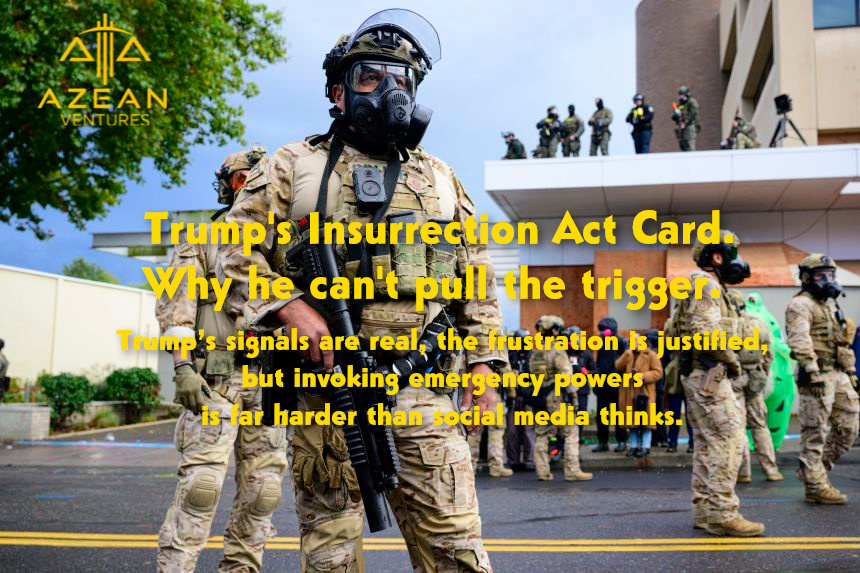
For months, speculation has surged that President Donald Trump is on the brink of invoking the Insurrection Act. The idea resonates emotionally with many Americans who believe serious wrongdoing by prior administrations has finally been exposed—particularly following document releases and public statements attributed to Director of National Intelligence Tulsi Gabbard. The frustration is understandable. But constitutional systems are not built on emotion or momentum. They are built on thresholds, procedures, and limits.
When those limits are examined carefully, the conclusion is uncomfortable but clear: invoking the Insurrection Act is unlikely, and it is not the legal mechanism designed to deliver accountability for political or intelligence-community misconduct. If accountability is coming, it will almost certainly come through courts, investigations, and institutional processes, not through emergency military authority.
1. What the Insurrection Act Is — and What It Is Not.
First and foremost, everyone needs to understand what “Insurrection” means. The plain-language definition:
An insurrection is an organized uprising where people or authorities use force or violence to block the government from enforcing the law or carrying out its constitutional duties.
In simple terms:
It is when:
The law cannot be enforced,
Authority is actively defied, and
Force, violence, or armed resistance is involved.
If courts are working, elections are happening, and disputes are being fought with lawyers instead of weapons, that is not an insurrection—no matter how angry or unfair it feels.
The Insurrection Act is a narrow, emergency statute designed for one purpose: restoring the federal government’s ability to enforce the law when that enforcement has collapsed due to insurrection, rebellion or the refusal or inability of states to maintain order.
It is not a tool for:
prosecuting political rivals,
bypassing courts,
resolving intelligence scandals,
or punishing bureaucratic misconduct.
Even if every allegation currently circulating were true, the Insurrection Act would still not be the appropriate legal instrument unless federal law enforcement had become impossible in practice, not merely difficult, contested or politicized.
That threshold has not been met.
2. Political Resistance Is Not Legal Collapse.
One of the most persistent misconceptions is that political resistance—sanctuary policies, hostile governors, activist judges or bureaucratic foot-dragging—automatically qualifies as “insurrection.”
It does not.
Why? Because the law requires more than disagreement or obstruction. It requires a condition where:
federal law exists but cannot be enforced,
courts are unable to function,
and state authority has effectively collapsed or turned openly hostile in a way that blocks federal authority entirely.
That is a very high bar. The current environment—however dysfunctional—does not meet it.
3. The Minnesota Example Shows the Limit Clearly.
Recent events in Minnesota have become a flashpoint in US political discourse, but they also illustrate why even heated conflict and federal–state clashes do not yet meet the constitutional threshold for invoking the Insurrection Act.
In early January 2026, a Minnesota woman, Renée Nicole Good, was fatally shot by an ICE agent during a federal immigration enforcement action in Minneapolis — an incident that has sparked intense public anger, protests and political firestorms. Minnesota Governor Tim Walz, angered by the incident, placed the Minnesota National Guard on preparatory alert and urged residents not to let the situation spiral into national escalation. State and city leaders, including the mayor of Minneapolis, have fiercely criticized the federal presence and filed lawsuits against the Department of Homeland Security and ICE, calling the operation a potential “federal invasion.”
On national media, Trump administration figures — including Stephen Miller — have publicly described local officials’ rhetoric as tantamount to encouragement of violence or “violent insurrection,” and some Republican lawmakers have openly called for invoking the Insurrection Act or even arresting Governor Walz after his remarks about the Guard. These high-profile comments have driven speculation that Washington may be positioning itself to escalate its response beyond courts and negotiations.
Yet none of these developments change the core constitutional and statutory requirements for the Act. The Insurrection Act is triggered only when federal law cannot be enforced through normal judicial or law-enforcement means because authority has collapsed or is being actively resisted in a specific jurisdiction. Even with dozens or hundreds of federal agents deployed, ongoing litigation, and political opposition, federal authorities in Minnesota have not been physically or legally prevented from performing their duties, nor has a court declared that federal law has become unenforceable within the state.
Because the federal judiciary is still functioning and the courts continue to hear legal challenges tied to the events, there is no judicial recognition of enforcement collapse — a critical element required in successful Insurrection Act invocations. Therefore, despite the noise on social media and aggressive commentary from partisans, the situation in Minnesota remains messy federalism, not constitutional breakdown. The legal bar for extraordinary federal action remains anchored in demonstrable enforcement failure, not political dissatisfaction or selective outrage.
4. The Insurrection Act Is Triggered by Place, Not Mood.
Every historical invocation of the Insurrection Act has shared one defining feature:
A specific state or locality where federal law could not be enforced.
The Insurrection Act is not a “nationwide aggregation” statute where unrelated problems in different states can be bundled together to justify a federal military response. U.S. law requires a concrete, geographically anchored breakdown of authority, not a mosaic of grievances spread across the map.
The statute is written in territorial terms, not systemic or atmospheric ones. It speaks to:
“a State”,
“combinations too powerful to be suppressed” within that state,
obstruction of federal law in that jurisdiction.
It does not say:
“when the country feels lawless,”
“when several governors misbehave,” or
“when federal authority is politically contested across multiple states.”
So legally, the President must be able to point to a defined place and say:
“Federal law cannot be executed here by ordinary means.”
Without that, the trigger is not met.
5. Why Problems in Different States Cannot Be “Stacked”.
A recurring claim among commentators is that while no single state has fully collapsed, the combined effect of resistance, disorder, and obstruction across multiple states should be enough to trigger the Insurrection Act. The logic is intuitive—but legally flawed. The Act was never designed to respond to a national “mood” of defiance or a distributed set of political conflicts.. Fragmented problems in different jurisdictions—even serious ones—do not satisfy that test unless they are coordinated, geographically anchored, and demonstrably beyond judicial or civilian control.
This is why, despite heightened rhetoric and visible institutional strain, invocation of the Insurrection Act remains unlikely. Federal law still functions: courts are open, cases are filed, injunctions are issued, funds are frozen, officials are subpoenaed and appeals are heard. Emergency statutes are not substitutes for due process; they are fail-safes for when due process no longer exists in practice.
And this is where realism must replace wishful thinking: believing the Insurrection Act is imminent may feel emotionally satisfying—but the legal and constitutional thresholds remain far higher than many want to admit.
6. Soldiers — Are NOT the Accountability Mechanism.
If wrongdoing has occurred, where does accountability actually come from?
The un-glamorous answer is: the courts.
That may disappoint those hoping for swift, dramatic justice. But it is also the only route that produces outcomes that:
Accountability mechanisms include:
None of these are fast. All are frustrating. But they are durable. If accountability is coming, it will come through the legal path.That path is slower. It is less cinematic. But it is the only path that preserves legitimacy.
A frequent objection is that the Department of Justice itself is compromised. There is historical evidence that institutions can be politicized. But institutional failure does not automatically authorize emergency military governance. Even a flawed DOJ can be compelled to act when evidence is strong, pressure is sustained and political cover collapses. The idea that military tribunals would replace civilian courts misunderstands both constitutional law and modern precedent. Even treason cases in U.S. history have overwhelmingly been handled by civilian courts.
Here’s the hard truth for Trump’s supporters. Those hoping for dramatic reckonings, a very difficult pill to swallow is this: constitutional justice is boring by design. It moves through filings, motions, depositions, sealed documents and appeals. It rewards patience not adrenaline. It rarely looks like a movie.
But when it works, it lasts.
7. Conclusion: Accountability Is Possible — Just Not the Way Many Expect.
It is unlikely that President Trump will be able to invoke the Insurrection Act because:
the legal thresholds have not been met,
federal authority has not collapsed,
courts remain operational,
and constitutional remedies remain available.
The Insurrection Act is not a shortcut around institutional failure. It is a last resort when institutions no longer function at all.
Final takeaway:
The Constitution is deliberately stubborn.
It forces presidents to solve problems through courts and institutions until those institutions truly fail in a specific place.
That is not weakness. That is the guardrail that keeps a republic from sliding into rule by force.