
By: Damian Fernandez
The High Court’s dismissal of Najib Razak’s application to serve the remainder of his sentence under house arrest would have been unremarkable — if not for the reasoning attributed to it.
According to media summaries, the learned judge held that a purported addendum to the royal pardon was legally ineffective because it was “inconsistent with the statutory framework,” reasoning that there is no legal mechanism for house arrest and that the alleged addendum “removes discretion” and therefore cannot stand.
Pause there.
Read that again.
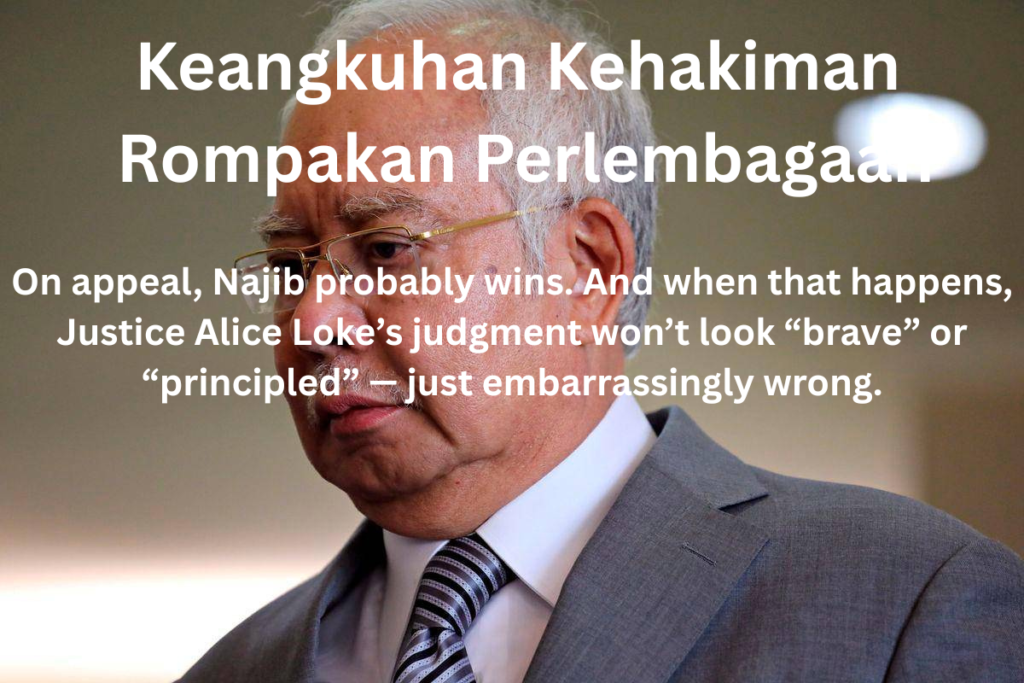
Najib will likely win this on appeal. And Justice Alice Loke’s decision will age like susu basi.
The implication is extraordinary: that a decree issued by the Yang di-Pertuan Agung, in the exercise of the royal prerogative of mercy, is subordinate to ordinary statutory law.
That is not a technical point. That is a constitutional landmine.
This is not about Najib Razak’s guilt, innocence, popularity or moral worth. He is a convicted former prime minister. That fact is settled. What is not settled — and should alarm every Malaysian — is whether the judiciary has now implied that the King is bound by Parliament in the exercise of a constitutional prerogative expressly vested in him.
If that proposition is allowed to stand, Malaysia has quietly crossed a line.
Article 42 of the Federal Constitution vests the power of pardon, reprieve, and commutation in the Yang di-Pertuan Agung, acting on advice.
This power is not created by statute. It is not derived from legislation. It is not conditional upon Parliament having first “provided a mechanism. It is a constitutional prerogative. To say that a royal decree cannot operate because Parliament has not legislated a specific procedural form for it is to invert the constitutional hierarchy. Statutes exist beneath the Constitution, not above it.
Article 42 of the Federal Constitution vests the power of pardon, reprieve and commutation in:
the Yang di-Pertuan Agung (for Federal Territories and federal offences), and
the Rulers / Governors (for state offences),
acting on the advice of the Pardons Board.
Crucially:
👉 The power is vested in the Agung, not in the Board.
The Board advises. The Agung decides. It seems that the learned judge disagrees!
This is where many judges (and commentators) conflate two very different ideas.
“Acting on advice” ≠ (does NOT equal) “rubber stamp”
“Advice” ≠ (is NOT) “binding command”
The pardon power is sui generis — a constitutional safety valve, not an administrative function.
If “acting on advice” meant the Agung must follow advice with no residual discretion, then:
The power would legally belong to the Pardons Board;
The Agung would merely be a ceremonial signing pen and Malaysia may as well have a Joe Biden style Autopen;
Article 42 would be pointless constitutional theatre.
That is not how pardons operate anywhere in the Commonwealth.
Short answer: Yes — constitutionally and logically.
Because the pardon power exists precisely for exceptional circumstances:
miscarriages of justice;
humanitarian considerations;
political prosecutions;
post-conviction developments.
In the context of the law and the constitution, the word “advise” primarily means “informational”. The advice requirement exists for three reasons:
court records;
prison reports;
medical conditions;
rehabilitation assessments.
The Board aggregates facts.
Advice ensures:
the decision is not arbitrary;
the process is documented;
accountability exists within the executive framework.
It prevents unilateral royal action without process, not without authority.
In short: 👉 Advice informs the exercise of power — it does not transfer ownership of the power.
This is where the High Court’s reasoning becomes deeply problematic.
Federal Constitution
⬆
Royal prerogative under the Constitution (Art 42)
⬆
Statutory law
A statute cannot:
remove a constitutional power;
narrow a constitutional discretion;
override a royal prerogative expressly entrenched in the Constitution.
If it could, Parliament could:
legislate limits on pardons;
criminalise clemency;
nullify Article 42 by ordinary law.
That would be constitutional vandalism.
“The addendum order removes that discretion and is therefore inconsistent with the statutory framework.”
This reverses constitutional logic. The correct question should have been:
“Can a statutory framework limit a discretion granted directly by the Constitution?”
The answer should be: No.
Statutes must adhere to the Constitution — not the other way around.
Even in constitutional monarchies with far weaker royal authority:
UK courts do not review pardons;
Canadian clemency is non-justiciable;
Indian presidential pardons are reviewable only for procedural mala fide, not substance.
Malaysia’s Article 42 is stronger, not weaker.
The Agong is not subordinate to the Pardons Board.
“Advice” is informational, not coercive.
Article 42 power cannot be fettered by statute.
Courts may not review constitutional authority.
Treating royal decrees as subordinate to statutes is a constitutional inversion.
The mercy power exists precisely because it operates outside rigid statutory sentencing frameworks. That is its purpose. Mercy, by definition, is discretionary. It is exceptional. It is not meant to be neatly boxed into the Penal Code or the Prison Act.
If Parliament could limit the scope of royal clemency simply by omission — by not legislating mechanisms — then Parliament would, in effect, control the King’s constitutional powers through silence.
That is constitutionally incoherent.
The assertion that there is “no legal mechanism for house arrest” misses the point entirely.
A pardon does not require Parliament to pre-approve its logistics. When a sentence is commuted, reduced, or altered, the administrative machinery follows the legal outcome — not the other way around. Malaysia did not have a detailed statutory playbook for many past royal commutations either. Did that invalidate them? Of course not.
House arrest is not a legal category — it is an effect. If a sentence is commuted to detention at a specified residence under conditions imposed by the executive, the legal authority flows from the pardon itself. To argue otherwise is like saying a prisoner cannot be released early because the prison department has not yet printed the right form.
Administration follows authority. Authority does not wait for administration.
The judge is reported to have said that the addendum “removes discretion” and is therefore inconsistent with the statutory framework. This raises an even more troubling question: whose discretion is being protected here?
Certainly not the King’s. Certainly not the Pardons Board’s. The only discretion being “removed” is that of the executive and prison authorities — discretion they never constitutionally possessed in the first place. Once a valid pardon or commutation is granted, implementation is not discretionary. It is mandatory. Prison officials do not get to “interpret” royal mercy. They execute it.
To frame this as a loss of discretion is to elevate administrative convenience above constitutional command.
That is backwards.
Here lies the core issue the court appears to have stumbled into.
Is the Yang di-Pertuan Agung, when exercising a power explicitly conferred by the Constitution, bound by statutory limits passed by Parliament? If the answer is “yes,” then Article 42 is meaningless unless Parliament approves its scope. The King becomes a ceremonial clerk executing laws rather than a constitutional monarch vested with specific prerogatives.
Imagine a British court telling King Charles III that he cannot exercise the royal prerogative of mercy because Parliament has not legislated the proper procedure for it. The suggestion would be laughed out of court. Yet, that is effectively the reasoning being implied here.
Malaysia is not a republic. The King is not a decorative symbol. The Constitution did not accidentally include Article 42.
Courts do have the power to review whether constitutional processes are followed. But review is not replacement.
The judiciary does not get to rewrite constitutional powers simply because the outcome is uncomfortable, politically sensitive or administratively inconvenient. Once the court crosses from reviewing legality into redefining constitutional authority, it stops being an interpreter of law and becomes its author.
That is not judicial independence. That is judicial supremacy.
And it is just as dangerous as executive overreach.
Today it is Najib. Tomorrow it could be anyone. If royal decrees can be neutralised by arguing that Parliament did not create a mechanism — then no future act of mercy is safe from bureaucratic sabotage.
Worse, it quietly recasts Malaysia’s constitutional monarchy as a conditional institution — powerful only when convenient, irrelevant when not.
That is not how constitutions work. And it is not how separation of powers survives.
Najib Razak may or may not deserve house arrest. Reasonable people can disagree.
But the Constitution is not a popularity contest.
If a royal decree exists, the question is not whether officials are comfortable with it, or whether statutes anticipated it. The question is whether the Constitution allows it. And on that point, the reasoning attributed to the High Court is deeply troubling.
The written judgment, when released, will matter enormously. Because if the logic stands, Malaysia has just quietly declared that the King answers to Parliament — and the Constitution answers to neither.
That would be a constitutional tragedy dressed up as legal technicality.
And it deserves far more scrutiny than it has received so far.