
Trump Wins, Malaysia Buckles. Trump Ends Malaysia’s Economic Apartheid.
How Trump’s & Tengku Zafrul’s Reciprocal Trade Deal Quietly Ended Malaysia’s Bumiputra-First Policies Without a Political Uprising
Part 1 of 3 Parts
By: Damian Fernandez.
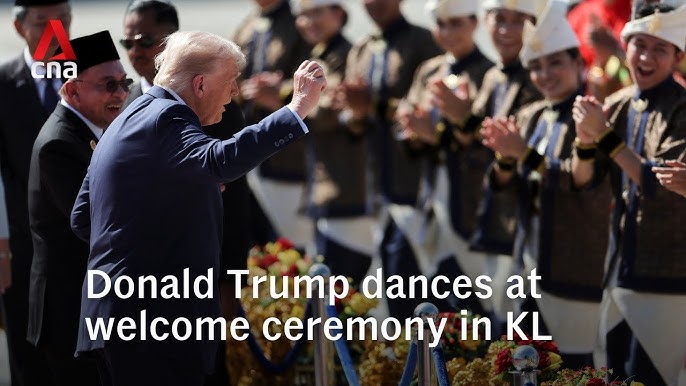
When Donald Trump stepped off Air Force One in Kuala Lumpur for the ASEAN Summit this week, he was greeted with the usual fanfare, including traditional dance, which he joined sportingly. Days earlier, the White House had released the full text of the U.S.–Malaysia Reciprocal Trade Agreement, a document that looks, at first glance, like yet another of Trump’s muscular “America First” tariff deals.
To understand the nuances in the treaty, it is imperative that the White House briefing be reviewed –
Read between the lines, and something far more profound emerges. This isn’t just a trade pact. It’s a strategic reset — one that effectively pulls the plug on Malaysia’s decades-old Bumiputra-First policies, but does so so quietly and elegantly that few within Malaysia’s political establishment have even noticed the full implications yet.
And in doing so, Trump may have accomplished what no Malaysian leader has dared: setting Malaysia on a path toward a more open, meritocratic, globally integrated economy — without firing a shot or triggering a populist backlash.
The Tariff Mirage: How Malaysia “Won” by Losing
For months, Malaysian officials fought to reduce the 24% tariff Washington had initially imposed under Executive Order 14257. The final deal — signed October 26 — locks in a reciprocal 19% rate for Malaysia, with over 1,200 export products reportedly exempted entirely.
To the untrained eye, that looks like a win for Malaysia. But that’s the surface narrative — a political fig leaf that Trade Minister Tengku Zafrul Aziz can hold up to Parliament and the public as a triumph of Malaysian diplomacy.
In truth, Malaysia had to concede more than anyone is publicly admitting. The fine print shows that the U.S. won deep access to key Malaysian sectors, including chemicals, automotive, electrical equipment, agricultural exports, and even critical minerals.
Malaysia agreed to:
Accept U.S. safety and emissions standards for vehicles, allowing American-made cars into the market without conforming to Malaysian bureaucratic red tape.
Streamline halal certification and import licensing — a quiet but profound loosening of the religious gatekeeping that long disadvantaged non-Muslim businesses.
Open its critical minerals and rare-earth sectors to U.S. partnerships, guaranteeing no export bans or quotas and granting extended operating licences to U.S. companies.
Refrain from imposing digital services taxes that would hit U.S. tech firms, scrap plans for local revenue-sharing with global platforms, and remove restrictions on U.S. broadcasting content.
In exchange, the U.S. kept the optics of toughness — maintaining the 19% tariff headline — while exempting Malaysia’s most strategic exports such as semiconductors, pharmaceuticals, and aerospace components.
It’s a masterclass in asymmetry: Washington kept leverage, Malaysia kept face.
The Subtle Dismantling of Bumiputra Economics
To understand why this deal matters so much, one must appreciate what it quietly undermines: Malaysia’s race-based economic architecture.
Since the 1970s, the Bumiputra First policy has given ethnic Malays preferential access to contracts, equity ownership, education, and employment. These policies — though intended to redress historical imbalances — have crystallized into a form of economic apartheid that stifles competitiveness, drives away investment, and marginalizes non-Bumiputra citizens who make up more than 40% of the population.
Trump’s trade negotiators appear to have understood this perfectly. By tying tariff relief to market access, regulatory neutrality, and digital openness, the U.S. effectively forced Malaysia to start dismantling its protectionist economic machinery — without using the politically radioactive term “reform.”
Malaysia’s pledge to refrain from discriminatory digital taxation, accept foreign certificates, and streamline approvals is code for deregulation — the very mechanism that sustains the Bumiputra system.
And crucially, by embedding these obligations into an international trade treaty, the Trump administration has ensured that any new government that may rise in Malaysia cannot easily reverse them without triggering trade penalties.
The Off-Ramp That Saves Face
Malaysia couldn’t have sold this domestically as “the end of Bumiputra protection.” That would have been political suicide.
So Tengku Zafrul’s ministry framed it as a “reciprocal trade deal” — a phrase that flatters Malaysian pride while hiding the reformist medicine inside.
Trump’s team gave Malaysia an off-ramp, not an ultimatum. The message was clear:
“You can keep your slogans — but open your markets, clean up your bureaucracy, and play fair.”
And Zafrul played his part brilliantly. By emphasizing Malaysia’s “reciprocal tariff reduction” and “enhanced export access,” he kept the local narrative intact. But Washington knows what really changed.
Behind the scenes, the Bumiputra wall has started to crack.
Who Really Benefits: The Non-Bumiputra and the Forgotten Middle
While the indigenous political elite clings to the illusion of control, Malaysia’s non-Bumiputra entrepreneurs — Chinese, Indian, Eurasian and others — stand to benefit the most.
Freer digital trade means tech startups can partner directly with U.S. investors without going through politically connected intermediaries.
The removal of local content rules and licensing bottlenecks means manufacturers and exporters can compete on merit, not on political patronage.
Streamlined halal certification (long a barrier to non-Muslim producers) means greater access to both domestic and foreign markets.
And as the U.S. partners with Malaysia in the critical minerals and semiconductor sectors, new joint ventures will likely be built on merit, not ethnicity.
For decades, Malaysia’s private sector has been split — one world of rent-seekers with political ties, another of quiet achievers building global-class businesses despite systemic bias. This deal may finally tilt the scales.
This is not a small shift. It’s an economic rebalancing that could unlock dormant potential across Malaysia’s Chinese, Indian, and non-Malay business communities — many of whom have long felt marginalized by Bumiputra quotas.
Trump didn’t set out to “liberate” Malaysia’s economy. But that may be the unintended (or perhaps very intended) consequence.
Why Trump & Tengku Zafrul Did It: The Big Picture
It’s easy to see this as Trump just playing economic hardball. But there’s a deeper strategy.
By nudging Malaysia — and, by extension, Southeast Asia — toward open markets, Trump is undermining China’s regional economic leverage and eroding Beijing’s influence over Muslim-majority economies that rely on state-centric industrial policy.
He’s also consolidating supply-chain resilience for the U.S. across ASEAN, positioning Malaysia as a preferred partner in critical minerals, rare-earths, and semiconductors — sectors vital for America’s technological and military independence.
And domestically, he gets to say:
“America wins again. We opened Malaysia, created U.S. jobs, and levelled the playing field.”
For Washington, this is diplomacy with dividends. For Malaysia, it’s reform without riots.
The Political Earthquake Yet to Come
The question now is whether Malaysia’s political class fully understands what it has signed away. Probably not – yet!
Trump’s negotiators have effectively internationalized Malaysia’s economic reform process. These changes cannot easily be undone — even by a future government — because the commitments are now treaty-bound and backed by U.S. national-security considerations.
The biggest irony? The Bumiputra First system was not dismantled through domestic protest or parliamentary reform — but through American trade leverage.
And it won’t be Tengku Zafrul or Anwar Ibrahim who claim the credit. History may record that Donald Trump — the man the Malaysian press mocked as brash and unpredictable — was the one who quietly pushed Malaysia into the 21st-century global economy.
The End of the Old Malaysia
Yes, Trump wins. Yes, Malaysia buckles.
But it’s not the humiliation many assume. For the first time in decades, Malaysia’s entrepreneurs — not its bureaucrats — may be the ones steering its economy.
Trump didn’t just win a trade war; he has ended Malaysia’s economic apartheid through a combination of blunt tariffs and quiet diplomacy.
And Tengku Zafrul, to his credit, understood that to save Malaysia’s future, he’d have to let go of its past — one clause, one exemption, one “reciprocal” promise at a time.